Lee “LD” Estes, the face of The Nations silo mural, marks his 100th birthday
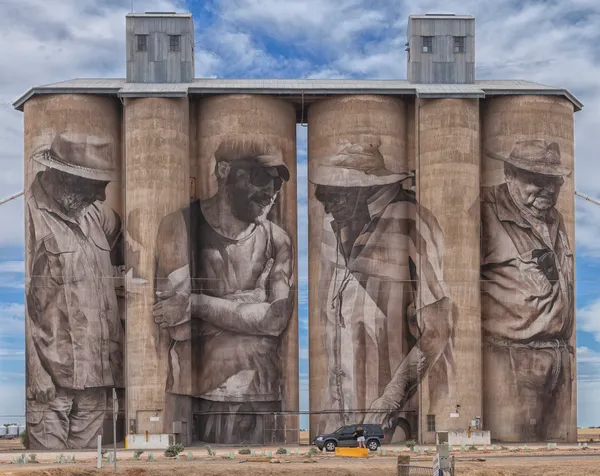
A familiar landmark in West Nashville now has a centenarian story behind it
Lee “LD” Estes, the Nashville native whose likeness appears on the towering black-and-white mural on an abandoned grain silo in The Nations, has celebrated his 100th birthday. The portrait, visible from surrounding streets and new developments, has become one of the neighborhood’s most recognizable pieces of large-scale public art.
The mural is painted on the side of a former industrial silo that long served as a prominent structure in The Nations, a community that has undergone significant redevelopment in the last decade. The artwork is widely described as a photo-realistic portrait rendered at an exceptionally large scale, turning a once-functional building into a visual marker for the area.
How the mural was created and why Estes was chosen
The work was completed in 2017 by Australian muralist Guido van Helten as part of the Nashville Walls Project, a program that has brought international and local artists to create public-facing murals across the city. Reporting and public documentation surrounding the project describe Estes as a longtime resident who has lived in or near The Nations since the early 20th century.
In features published at the time the mural was painted, Estes was presented as a living representative of the neighborhood’s continuity—someone whose life spans eras of The Nations that predate recent growth. The mural’s placement and scale have also tied it to the area’s transformation, as the silo sits near major new residential and commercial investment.
Subject: Lee “LD” Estes, a longtime The Nations resident
Artist: Guido van Helten
Year completed: 2017
Location: The Nations, West Nashville (painted on an abandoned silo)
A public image tied to neighborhood change
The Nations silo portrait has been repeatedly interpreted in coverage and local public-art summaries as an emblem of transition: an older resident’s face looking out over a rapidly changing skyline of new construction. That narrative has remained central to how the mural is discussed, particularly as the silo and surrounding parcels have been incorporated into broader redevelopment branding and tourism-oriented guides to Nashville’s murals.
The mural’s prominence has made it both a community landmark and a widely photographed stop for visitors seeking Nashville’s large-format street art.
What the milestone adds to the mural’s meaning
Estes reaching 100 adds a concrete, verifiable milestone to a work that has often been framed in symbolic terms. The portrait is not a historical figure or an abstract icon: it is a depiction of a living Nashvillian whose age now matches the century-scale timeline frequently invoked in discussions of urban change.
As Nashville continues to expand, the mural’s subject remains a reminder that the city’s growth sits alongside long, local lives—some of which can still be found in the neighborhoods being reshaped.

Juuse Saros’ 43-save night and Ryan Ufko’s first NHL goal lift Predators past Kraken

MNPD Street Racer Initiative results in three arrests and recovery of two firearms across Nashville

Unclaimed U.S. Navy veteran Lonnie Dee Wayman laid to rest in Nashville with full military honors
