Boring Company’s Nashville tunnel work pauses as early digging awaits local permits and inspections
Work is underway, but approvals remain a gating issue
The Boring Company’s planned Nashville tunnel system—marketed as the Music City Loop—has moved into early on-site activity while still awaiting a range of permits and inspections needed to proceed with full-scale excavation and construction. The project, announced in July 2025, is intended to link downtown Nashville and the Music City Center area with Nashville International Airport using a network of tunnels beneath state-owned roadways.
State officials have described the effort as privately funded, with the state providing access to certain public properties and rights-of-way. A key early step came when a state building commission executive committee approved an agreement allowing the company to use a state-owned parking lot in downtown Nashville as a staging location, with conditions that the site be restored and returned within a defined period.
What the project proposes—and what has changed since the initial announcement
Early public descriptions centered on roughly 10 miles of tunnels and an estimated travel time of about eight minutes between downtown and the airport. More recent project materials describe a broader system approaching 13 miles, expanding the concept beyond a single downtown-to-airport run and including additional downtown and West End-area destinations.
The system is designed around passenger trips in dedicated Tesla vehicles operating inside tunnels. Project statements have emphasized adherence to NFPA 130, a widely used fire and life safety standard for fixed guideway transit and passenger rail systems.
Why permits matter: city right-of-way, encroachments, and inspection authority
Even when a route is largely planned under state-owned roadways, construction activities can trigger multiple layers of approval. Nashville’s transportation permitting framework requires right-of-way permits for work affecting streets and public space, and an encroachment permit process for features placed in or crossing Metro right-of-way. The encroachment process is notable because it requires Metro Council approval, potentially adding a legislative timeline on top of technical review.
Separately, the state has indicated that details of its inspection process for the tunnel work were still being finalized after the project announcement. That sequencing—site setup and preliminary work followed by multi-agency approvals—helps explain how visible activity can occur while major digging remains constrained.
Visible site preparation and equipment deployment
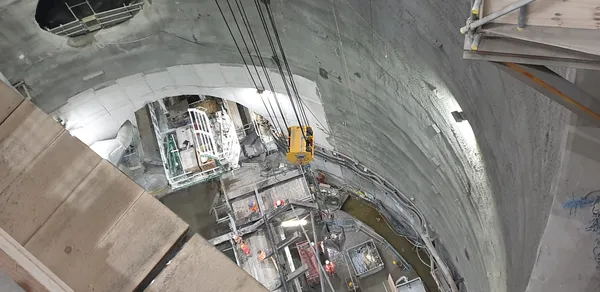
Since late 2025, the company has publicized the deployment in Nashville of above-ground rock removal conveyor infrastructure used to move excavated material from tunnel operations. Such systems are typically installed ahead of sustained boring operations and are dependent on the timing of permits, access agreements, and inspection protocols.
Key open questions
- Which specific Metro permits and Council approvals, if any, will be required for station entrances, ventilation or safety infrastructure, and surface-level encroachments.
- How the state and local inspection regimes will be coordinated for tunneling under or adjacent to public roads.
- What schedule revisions may follow from the permitting timeline, given earlier projections targeting initial operations in 2026.
As of January 20, 2026, the project has advanced through early state-level property access steps and site setup, while broader permitting and inspection processes continue to shape when large-scale tunneling can proceed.